
Immersive Technology (XR)
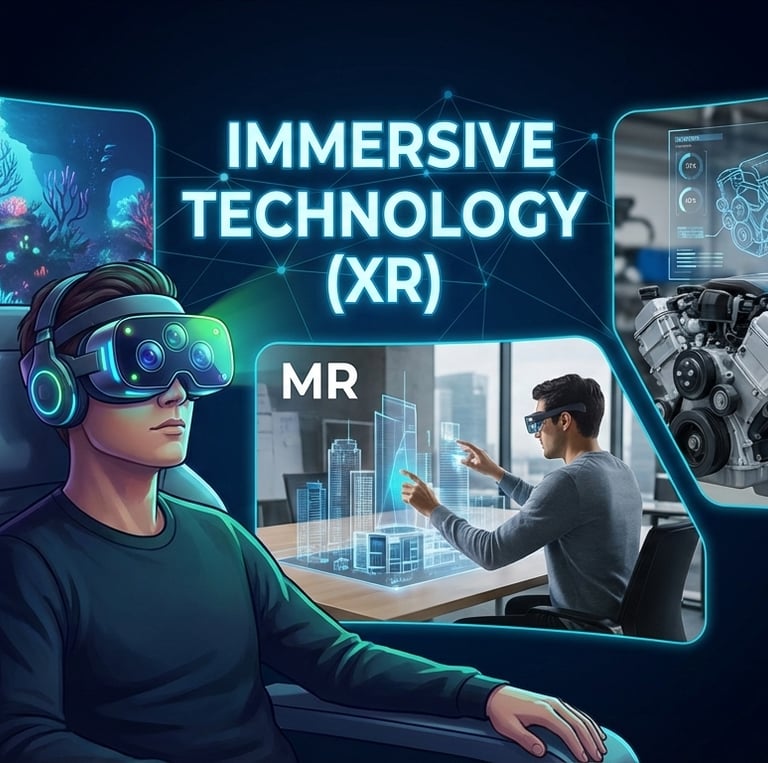
This domain explores the application of Extended Reality (XR), including Augmented Reality (AR) and Virtual Reality (VR), to facilitate spatial visualization and molecular interaction in three-dimensional environments. Immersive technologies enable learners to manipulate atomic structures, reaction mechanisms, and dynamic processes, thereby strengthening spatial reasoning, conceptual clarity, and experiential learning in chemistry education.
Research Projects:
Comparative Study of Virtual and Traditional Labs in PBL
AR-Integrated Gamified Learning Media
STEM-Based AR E-Module
Mobile AR Application
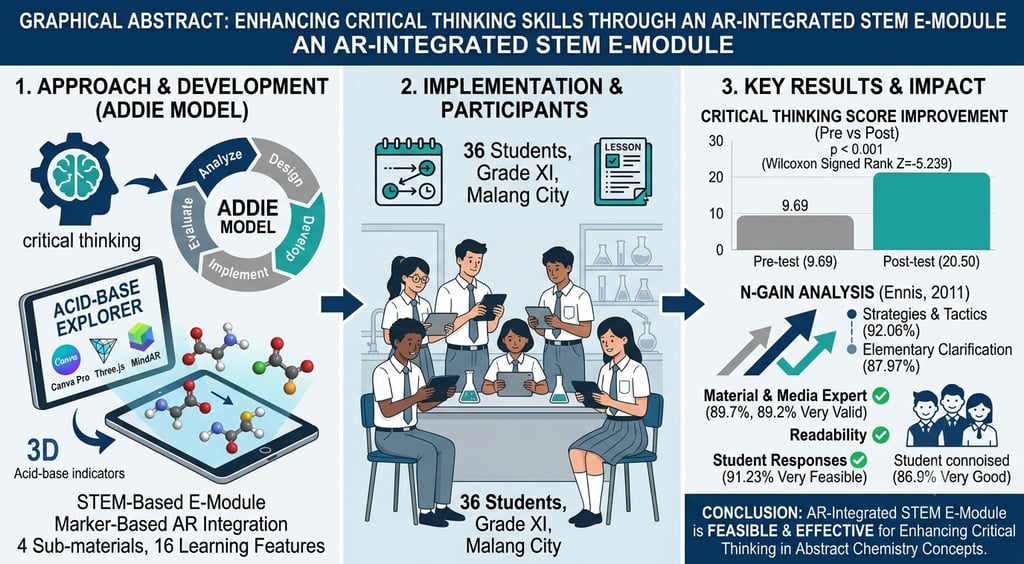
Development of STEM-Based E-Modules Integrated with Augmented Reality (AR) on Acid-Base Material to Improve High School Students' Critical Thinking Skills
This study describes the development and evaluation of Acid-Base Explorer, a STEM-based e-module integrated with Augmented Reality (AR), designed to enhance high school students’ critical thinking skills in acid-base chemistry. Developed using the ADDIE model, the e-module incorporates marker-based AR through Three.js and MindAR and presents four main subtopics through 16 structured learning features. The validation results from material and media experts, together with the readability test, indicate that the product is highly valid and feasible for classroom use. Its implementation with 36 Grade XI students showed a significant improvement in critical thinking scores, supported by the Wilcoxon Signed Rank Test and N-Gain analysis across Ennis’ critical thinking indicators. Student responses were also highly positive, suggesting that the AR-integrated STEM e-module is a promising instructional medium for helping students understand abstract chemistry concepts and develop critical thinking skills.